
Connecting with Vassar’s Trees:
Revealing Our Collective Consciousness
In collaboration with:
The Vassar Office of Sustainability, The Vassar Arboretum, and More-than-humans throughout Vassar College’s Campus
It’s time to liberate our attention and loosen our expectations.
Vassar is embarking on a collaborative, experimental project and you are invited to join us!
HOW TO PARTICIPATE
Welcome! Thank you for already listening to your curiosity. If you would like to embark further, please see the guidelines or view the video below. We hope you have fun!
GUIDELINES FOR CONTRIBUTING:
Say “hello” to our featured tree collaborator!
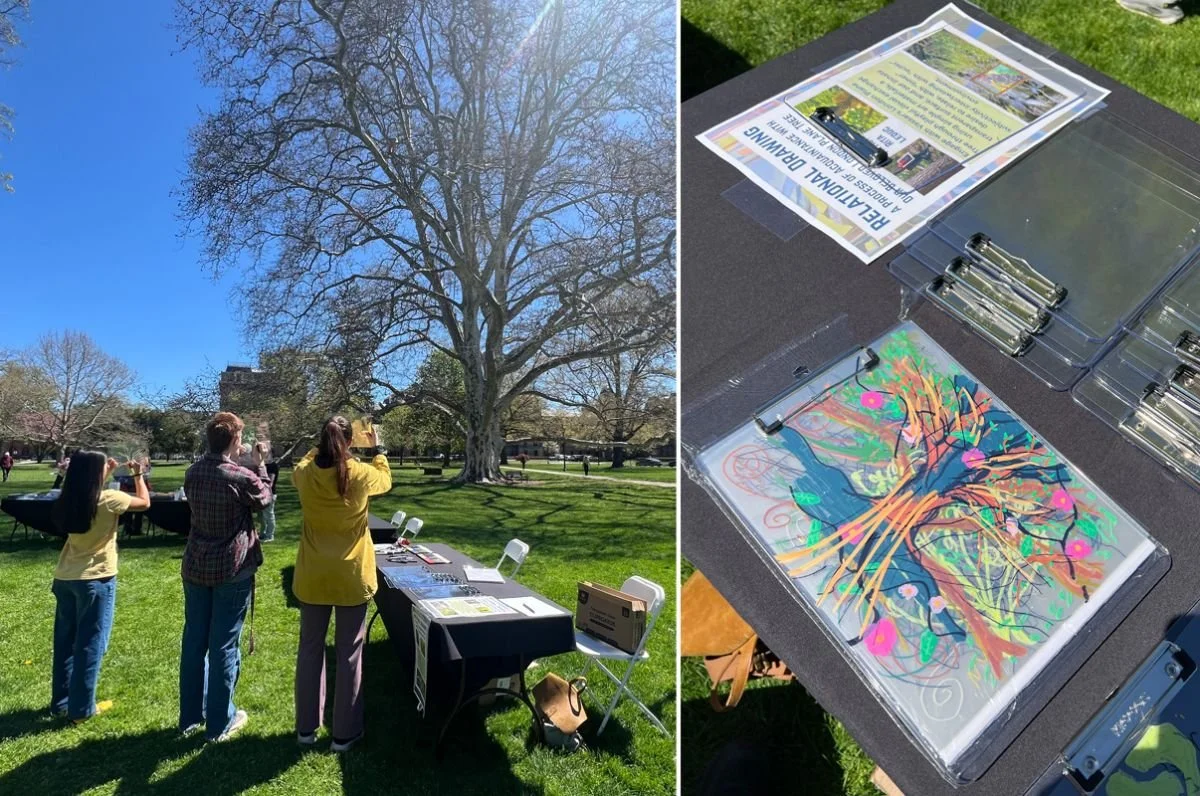
Have a look inside the toolbox. The combo on the lock is 8426; then press the square on the front of the lock to open it. Inside of the toolbox, you will find clear clipboards, transparency films, and dual-tipped acrylic paint markers.
Secure a transparency film onto a clipboard: this is your surface.
Choose a vantage point that is comfortable, safe, and unobstructed by self-consciousness. This will facilitate openness and play! Hold up and peer through your surface to the collaborating tree.
Using any color and any side of a dual-tipped marker, mark what catches your attention.
Fear not: representing what you see is not the goal! Simply mark your attention by contributing lines, shapes, colors, textures, and gestures onto the film.
When you notice your attention fading (this includes attention that moves toward the transparent surface rather than what lies beyond), find another moment of attention and continue making marks. Switch colors and/or marker tips any time you feel inspired to do so.
Repeat until your attention has shifted away from the exercise entirely. Stay as long as you’d like, or as long as your schedule allows!
When you decide to stop, date the film (bottom right corner is preferable).
Take a photo of the piece and email it to Ken Foster, Director of Sustainability at: kfoster@vassar.edu. This will put you on the email list to be invited to an upcoming gathering commemorating our collectED collectIVE consciousness experiences.
Place your finished film carefully back into the toolbox and secure the lock.
Enjoy the rest of your day!
Stay tuned for that email from Ken about a celebratory gathering!
THANK YOU FOR COLLABORATING WITH US!
-
The Vassar community loves its trees and its campus.
But we humans, to one degree or another, suffer from a disconnectedness from the vibrant and wonderful more-than-human world in which we live and breathe.
This experimental, participatory art project draws the humans of Vassar into new relationships with the trees of Vassar, nurturing a collective consciousness that facilitates renewed connection in these years of crisis. With openness and creativity, bridges can be built across modernity's human-nature divide, ushering in wonder, embodied wisdom, and rejuvenated purpose.
For each month of the Fall semester, one tree on campus will be featured as master of ceremonies. At the tree’s base is a toolbox containing acrylic markers, clear clip boards, and transparency sheets. A QR code leads to a (this) webpage that loosely guides (liberates!) human participants to connect with the tree and its surrounds by holding up and peering through the clear sheet, activating one’s innate desire to relate. From there, with the markers and each other, they play, as the clear sheet becomes the canvas on which lines, colors, textures, and shapes represent engagement between human, tree, and everything in-between.
As "inner" subjectivity intertwines with "outer" environment, participants enter into a visual dance that blurs boundaries and reconnects relations. Resulting “art-ifacts”—the transparency sheets—bear witness to this. Human participants are encouraged to leave these sheets inside the toolbox.
At the end of the semester, The Office of Sustainability will host an interdisciplinary gathering to celebrate the “collective consciousness” that revealed itself at each location. A sign stand containing the layered “art-ifacts” will be placed at the base of each tree. With its diversity of colors, marks, textures, speeds, and shapes, it will visualize the infinite creative potential that is swirling around campus at all times, ready to engage. Further, through saturation, concentration, reflection, and transparency, it will invite passersby into their own expansive moments of interconnection.
Those who participate will:
Enter into a new relationship with the trees and ecosystem(s) of Vassar
Experience the freedom to be creative, without judgement or pressure
Learn more about themselves, how they see and experience the world
Enjoy stepping away from the busyness of life to say “yes” to their attention
Have the opportunity to engage with others who participate
-
My practice is a “process of acquaintance.” I listen, absorb, participate, and eventually, become.
Initially, I (Rita Leduc—hi!) created this exercise for myself as a way to reorient toward process and presence. I wanted to undo a trained impulse toward anxiety-inducing, scarcity-minded, goal-orientation. Through the practice of peering through a near-invisible surface, out into an infinitely complex one, scrambling to notate a fleeting moment of attention…I am simultaneously fully liberated and connected. Then, because of (not despite) this immersion in my present moment, something deeply honest is revealed. As I co-create with it, I further open myself into the relationship. In a way, I myself become transparent: a conduit for primal authenticity and creativity that spans well beyond myself. I’m in it, with it, of it. By reawakening it in me, my understanding infinitely deepens, as does my own becoming. This genuine, creative, relationally-driven posture engrains itself into my nervous system. Outside of this exercise, the posture shows up, mentoring my intuition, empathy, relational prowess, and systems dexterity.
But first and foremost, it’s fun.
There are a lot of reasons why I believe this is a joyful and necessary exercise today, and they span personal to planetary scales. These include:
Practicing sensing our own intuitions [which help us activate our human agency and discern our individual and collective paths of potential].
Remembering what it feels like to play [and see how necessary play is for imagination and thus potential to present themselves].
Reawakening, permitting, and expanding the imagination [in a time when we need to channel and spread new, creative, energized possibility states].
Exercising the “muscles” that set and dissolve boundaries [clocking the surprises and practicing the empathy that results—this scales to different degrees of boundaries].
Wholly grounding ourselves in our inner-outer relational continuum [as a counterbalance to the attention economy, AI, and our increasing inability to connect with anything outside of our own psyches].
Experiencing and witnessing novel creativity [that results when we identify with our inner-outer relational continuum as one connected organism—this also scales “up” the stack].
Discovering, safely and whimsically, how much we truly don’t know [and how to approach the unknown with curiosity and reverence].
-
Isn’t it just a mess of marks haphazardly stacked and framed?
Yes, and isn’t it the most imperfect, beautiful thing?
Consider the statement:
The “art-ifact” that results is a visual manifestation of a possibility space that is created when self equalizes with world.
When two entities equalize, the boundary between them dissolves. For example, when ice melts and steam condensates, resulting water from both parties swirls and swishes together.
This exercise encourages a similar intermingling between our “inner” selves and “outer” environment. It starts with an individual human participant’s intersection with time and space. Eventually, it combines many human participants, times, and spaces, revealing moments of attention, surprise, collaboration, and connection. It becomes a visualization of the diversity of potential swirling around us at all times, even when we don’t pay it any mind. Choppy, hot orange squiggles are always possible. Low, deep purple rhythms are ever-present. Whom will you call upon?
Because each bit of mark-making is a one-off, the stakes are high and I feel vulnerable. But because each piece is immediate and imperfect, the stakes are also low and I feel playful. This invested improvisation encapsulates the dynamism, complexity, and intimacy available in every process of acquaintance.
Sandwiched between upcycled acrylic and installed at or near their origin sites, the resulting amalgamation of drawings allows visitors to engage with a series of marks made between multiple hands, memories, moods, experiences, perspectives, and more-than-human collaborators. The final piece could have neither been predicted nor designed, and yet it exists, as does the energy it is putting out into the world. The same can be said for each collaborating tree, human, etc….
For curious passersby, the layered, active marks offer a window into a world of dissolved boundaries, reconnected relations, and imaginative potential. And through moments of transparency that reveal the ecosystem beyond, the piece invites said passersby to dive into their own.
-
Optional questions worth taking along for the ride:
How did it feel to permit yourself to follow your attention and enter into a playful state?
Did connecting with more-than-human entities alter your relationship with your surroundings? If so, how?
How have you allowed intuitive awareness to navigate your life?*
When have you felt a barrier to being able to follow this orientation?*
How did you work (or play) your way around or through that barrier?*
*If the life questions are especially difficult, consider answering on behalf of someone you know.
*For anyone interested in coordinating a more specific engagement, please reach out to Rita directly here.
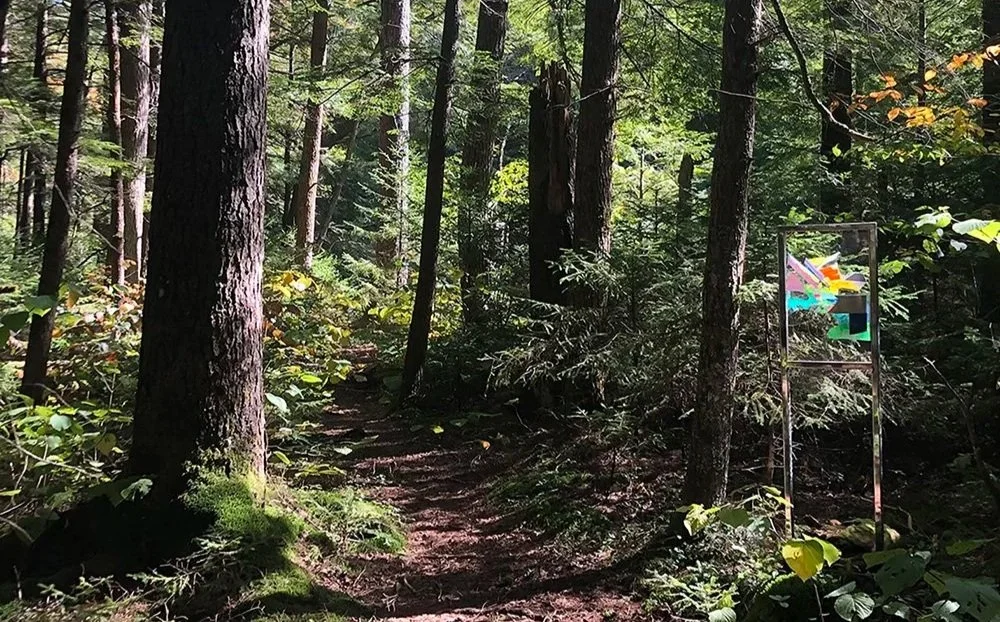
Hubbard Brook Field Mark (Brook Party) at Hubbard Brook Experimental Forest, NH
Many thanks to Eli, Lily, Ken Foster, Director of Sustainability, the Art Department, and the Vassar Artist Group for their assistance and support!
-
Great question, thanks for asking!
An excellent start to living more sustainably includes heightened awareness of materials and energy usage. However, impactful as this can be, it is not the end of the sustainability trajectory and can sometimes actually prevent people from cultivating a deeper, more embodied experience of “sustainability.” When one practices their relationships with more-than-human entities, “sustainability” grows from the inside out. We care because we are connected. We sense how “sustainability” relates not only to our disposal and consumption practices, but in how we spend our time and treat each other.
How does your energetic contribution to the world change when you feel connected to and well cared for by it?